
Two neighbors on the same Springfield street each have a red oak of roughly the same size that needs to come down. They call the same company, get the same arborist, and receive quotes that are nowhere near each other. Neither is being cheated. The price of taking a tree down is almost entirely a price for getting it down safely in the space available, and two yards that look alike from the sidewalk can be very different places to work. Here is what the arborist saw on each lot that the homeowners did not.

What is under the tree
The first yard has lawn on all sides and a driveway wide enough for the chip truck. The second has a patio, a hot tub, a fence line and a neighbor's shed within the drop zone, and a garden the owner would like to keep. On the first lot, large sections can be felled or lowered quickly; on the second, nearly every piece has to be rigged, roped and lowered by hand, which is slower, needs more people and carries more risk. The difference in the quote is mostly the difference in how many pieces the tree has to become before it is on the ground.
How the crew gets to it
Access is the second item. A tree that a bucket truck can reach from the driveway is one kind of job; a tree in the back corner of a lot with a narrow side yard, a gate and a slope is another, because the climber works from the tree and every piece of wood is carried out by hand or by a small machine that has to fit through the gate. In the older sections of Springfield, where houses sit close and the side yards were never designed for equipment, access is often the single largest factor in a quote. A crane can turn an all-day climb into a morning, but only where a crane can be parked, and on many Springfield cul-de-sacs it cannot.
The roots nobody can see
A removal is not only about the trunk. Where the stump is to be ground and the area replanted, or where a hardscape project is planned afterward, the arborist is thinking about what the roots of the remaining trees are doing under the lawn, and about what the removal equipment will do to them. Driving a machine across the root zone of the oak that is staying can do more lasting harm than the removal of the one that is going. The way roots spread under a Springfield yard, what trenching and grading do to them and how a crew protects the trees that remain is explained in Digging Near Your Trees in Springfield, VA: How to Keep the Roots Alive, and it accounts for a line item that surprises owners: the mats, the routing and the hand work that keep the surviving trees healthy.
The condition of the tree itself
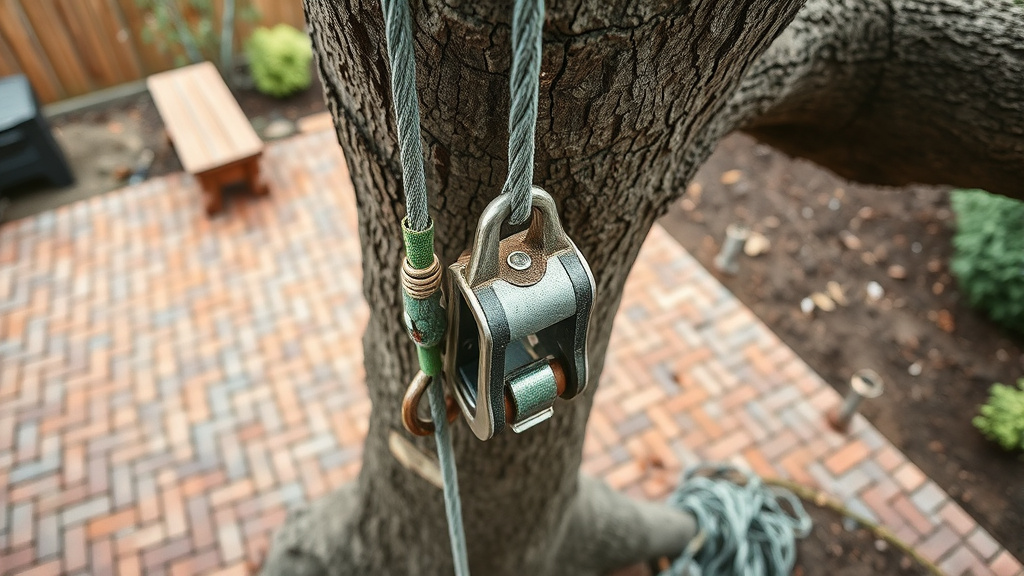
A sound tree is predictable to climb and cut; a dead or decayed one is not. Dead wood does not hold a climber's anchor the way live wood does, hollow trunks behave unpredictably when sections are cut, and a tree that has been dead for several seasons may have to be dismantled from a bucket or a crane rather than climbed at all. Owners sometimes assume a dead tree is cheaper because it is lighter; the quote often goes the other way, because the crew's margin for error has shrunk.
What the crew leaves behind
The quote also depends on what the owner wants the yard to look like afterward. Hauling all the wood and chips away is one price; leaving the logs cut to length for firewood and the chips in a pile for mulch is another; grinding the stump below grade and backfilling is a third. Each is a legitimate choice, and asking for the quote to be broken out this way lets an owner see which parts are the safety work and which are the clean-up they could do differently.
Reading two quotes side by side
A written quote should name the tree, say whether it will be climbed, bucketed or craned, state what is being rigged over, say what happens to the wood and the stump, and confirm the company's insurance. Two quotes that differ by a large margin usually differ in one of those lines rather than in the price of labor. Some of the myths that make owners misread a quote are taken apart in a piece on common misconceptions about what removal involves, and for owners weighing whether the wood and chips can be put to use on the property, there is a look at the more sustainable ways to handle a removal.
Who should be giving the quote
G&V Tree Service has been family-owned in Springfield since 2001. Its ISA Certified Arborists work to ANSI A300 standards, the company is a member of the Tree Care Industry Association and the International Society of Arboriculture, it is licensed and insured, and it does not subcontract, which means the arborist who walks the yard and explains the quote is the one whose crew does the work. Residential tree removal, trimming and pruning, stump grinding and emergency storm work are among its services, and the on-site estimate is free.
From Rolling Road to Brandon Avenue
West Springfield High School at 6100 Rolling Road stands in the middle of the neighborhoods where these back-corner oaks are most common; the G&V Tree Service office on Brandon Avenue is a short drive east across Springfield, and the route is mapped here.
G&V Tree Service Inc · 6434 Brandon Ave, Suite 204, Springfield, VA 22150 · (703) 569-2570
Questions owners ask when the quotes come in
Why is the quote higher for a dead tree? Dead wood is unpredictable to climb and cut, so the crew works more slowly and often from equipment rather than from the tree.
Would a crane make it cheaper? Sometimes, where a crane can be parked close enough; on many Springfield lots it cannot, and the job is climbed and rigged instead.
Can I lower the price by keeping the wood? Often, yes; ask for the hauling and stump grinding to be priced separately so you can decide.